You stop hearing the fuel pump prime when you turn the key, the A/C compressor clutch doesn't engage, the high beams won't turn on, or the radiator cooling fan never kicks in. You open the under-hood fuse box and find 15 identical black or gray cubes: the relays.
The most dangerous mistake people make is jamming bare wires or paperclips into the fuse box terminals to ‘jump the relay’: if you miss the right terminal by a millimeter and feed +12V directly into pin 85 or 86 coming from the vehicle's computer, you will fry the ECU in a split second.
A relay is a magnetic switch that allows a low-current signal from the computer to control a high-draw component (like the cooling fan or fuel pump). It has two separate circuits: 1) Control Circuit (Pins 85 and 86): This is a small electromagnetic coil (it should measure between 50 Ω and 120 Ω with a multimeter). 2) Power Circuit (Pin 30 power input and Pin 87 output to the motor/bulb): When the electromagnet is energized, it pulls a small contact closed that bridges Pin 30 to Pin 87.
1. Universal relay pinout table and what you should find in the fuse box
When you pull the relay from its socket in the car and test the fuse box terminals with your multimeter or P200 probe (with the ignition switch ON), here is what you should measure:
Save this standard ISO terminal pinout map:
| Relay Pin Number | Electrical Function | What You Should Measure at the Vehicle Socket (Ignition ON) |
|---|---|---|
| Pin 30 (Power Input) | Heavy-gauge power feed from a battery fuse | Constant +12.6V at all times (if it reads 0V, the main fuse is blown). |
| Pin 85 and Pin 86 (Control Coil) | One receives +12V ignition power and the other receives Ground from the ECU or switch | Between pins 85 and 86 on the removed relay, you should measure 50 Ω to 120 Ω with a multimeter. |
| Pin 87 (Output to Component) | Wire running directly to the pump, horn, lights, or cooling fan | With the P200 probe, you can inject circuit-protected +12V into socket 87 and the fan/pump will turn on immediately. |
2. The modern 60-second method without risky jumper wires
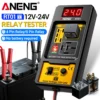
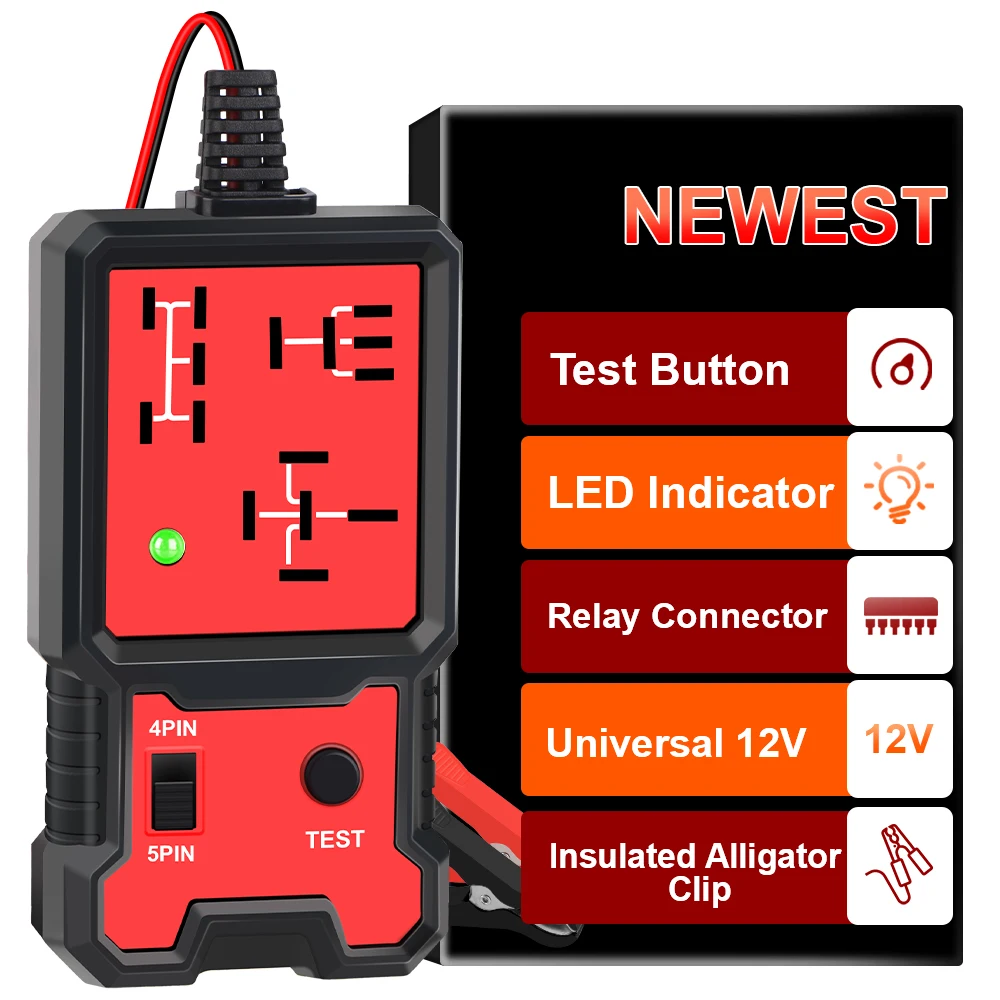
- Step 1 — Pull the suspected relay and plug it into the ANENG RT01 or CNBJ-707 tester: Connect the tester clamps to the vehicle battery, select 4-Pin or 5-Pin, and press ‘TEST’. The unit will cycle the relay multiple times, and if the internal contacts are burned, it will illuminate the red LED.
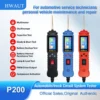
- Step 2 — Check both top test points of every fuse with the P200 probe: The P200 probe beeps with a high-pitched tone and red light on +12V, and a low-pitched tone with green light on Ground (GND), letting you check 40 fuses in 30 seconds.
- Step 3 — Power up the component from socket 87 using the P200's built-in breaker protection: Touch the P200 probe tip to the Pin 87 socket and press the rocker switch forward: the probe injects short-circuit-protected 12V so you can verify instantly whether the fuel pump or cooling fan works.
3. Gear up today with automotive electrical technicians' favorite tools
These three affordable tools pay for themselves on the very first electrical fault you solve at home or in the shop:
4. Frequently Asked Questions from Drivers and Repair Shops
1. Can I swap a relay with an identical one from the same fuse box to get out of a jam?
Yes, as long as they have the exact same wiring diagram and part number printed on the housing (for example, you can temporarily borrow the horn or fog light relay to test the fuel pump relay).
2. What happens if I use the P200 probe on a wire that has a dead short to ground?
Nothing gets damaged: unlike a bare jumper wire that can catch fire, the P200 probe has an electronic thermal circuit breaker that cuts off current in milliseconds and alerts you on its screen that the wire is shorted.